









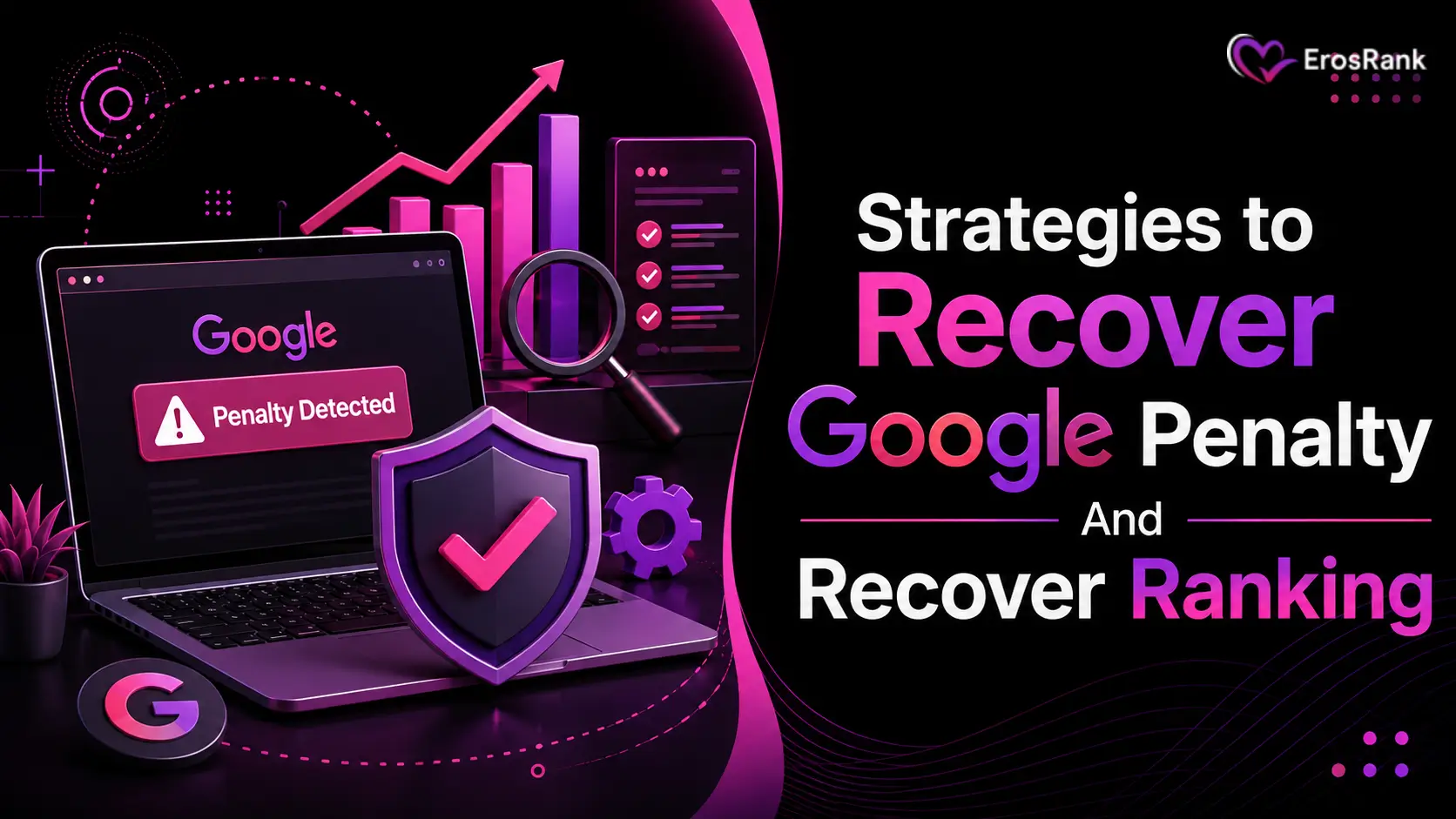
A sudden Google penalty can wipe out years of SEO progress, causing sharp declines in organic traffic, search visibility, and revenue. For adult business websites operating in a highly competitive niche, even a temporary ranking loss can result in missed opportunities & a significant drop in customer acquisition.
According to Google Search Central, Google’s ranking systems reward helpful, reliable, people-first content, while spam policies target manipulative practices like unnatural links and cloaking.
Recovering from a penalty is not about applying quick fixes; it requires structured adult website SEO recovery strategies that identify the underlying issue, address it systematically, as well as rebuild your site’s trust with search engines.
This post sheds light on key SEO strategies to remove penalties for adult business websites. These approaches can help your adult site regain lost rankings and restore sustainable organic growth.
So, let’s dive in!

What do Google Penalties Mean?
Google penalties refer to actions that affect your website’s visibility in Google Search when it violates Google’s Search Essentials or spam policies. These penalties can lower keyword rankings, decrease organic traffic, or remove web pages from search results altogether.
For adult business websites, a Google penalty can significantly impact traffic, memberships, subscriptions, along with revenue. The most common causes can be:
- Spammy backlinks
- Thin or duplicate content
- Keyword stuffing
- Cloaking
- Malware
- Other practices (affect user experience negatively or attempt to manipulate search rankings)
It’s also important to note that not every ranking drop is a Google penalty. Traffic can decline due to algorithm updates, technical SEO issues, or increased competition. Identifying the root cause is the first step toward an effective recovery strategy.
What Our Experts Suggest: Before making any SEO changes, check Google Search Console for manual actions & conduct a complete SEO audit to determine whether the issue is a manual penalty, an algorithmic impact, or a technical problem.
Why Are Adult Websites More Vulnerable to SEO Penalties?
Google does not penalize websites simply because they operate in the adult industry. However, adult businesses often face higher SEO risks due to aggressive marketing practices, large-scale content publishing, as well as intense competition. These factors increase the likelihood of violating Google’s Search Essentials and spam policies.
- Aggressive Link Building: Many adult websites rely on paid links, private blog networks (PBNs), reciprocal link exchanges, or automated backlink campaigns to gain rankings quickly. These manipulative practices create an unnatural link profile that Google’s algorithms & manual reviewers can identify, increasing the risk of ranking losses or manual actions.
- Thin or Duplicate Content: Adult websites often publish hundreds of category, performer, or location pages with minimal unique information. When various pages offer similar or low-value content, Google may overcome their visibility because they fail to satisfy search intent or demonstrate sufficient originality.
- Spammy Landing Pages: Creating several landing pages that target slight keyword variations without providing unique value can appear manipulative. Google considers these doorway pages because they exist primarily to rank for search terms rather than helping users with relevant, original content.
- AI-Generated Low-Quality Content: AI can improve content production, but publishing unedited, repetitive, or factually weak AI-generated content declines overall content quality. Pages that lack originality, expertise, or user value are less likely to perform well after Google’s Helpful Content as well as Spam updates.
- Cloaking & Black-Hat SEO: Practices such as cloaking, hidden text, keyword stuffing, deceptive redirects, or automated content generation violate Google’s spam policies. Although these tactics may deliver temporary ranking improvements, they often result in severe ranking drops once detected.
- Poor Technical SEO: Large adult websites frequently experience crawl errors, duplicate URLs, broken internal links, incorrect canonical tags, or slow-loading media pages. These technical issues make it harder for Google to crawl, index, plus rank significant pages efficiently.
- User-Generated Spam: Adult platforms with comments, forums, reviews, or user profiles can quickly accumulate spam if moderation is weak. Low-quality submissions, malicious links, and fake profiles can undermine overall website quality and negatively affect search performance.
- Malware or Security Issues: Adult websites are frequent targets for malware injections, phishing attacks, as well as unauthorized code changes. A compromised website can lose user trust, trigger Google security warnings, and experience significant ranking declines until the security issues are resolved.
What are the Different Types of SEO Penalties That Affect Adult Websites
Adult websites can lose search visibility. Identifying the exact issue helps you choose the right recovery strategy:
Manual Actions: Occurs when Google’s review team determines that your website violates its spam policies. Unlike algorithmic penalties, you will receive a notification in Google Search Console explaining the issue. It may happen due to:
- Unnatural or paid backlinks
- Thin, duplicate, or auto-generated content
- Cloaking or misleading redirects
- Hidden text or keyword stuffing
- User-generated spam
- Hacked or compromised pages
How to recover it: Fix the reported issues & submit a reconsideration request through Google Search Console.
Algorithmic Penalties: It happens when Google’s systems detect low-quality content or manipulative SEO practices. Unlike manual actions, you will not receive a notification, but your rankings & organic traffic may drop after a Google update.
- Helpful Content Update: Targets thin, AI-generated, or search-first content. Rewards helpful, original, along with user-focused content.
- Spam Updates: Penalizes spam tactics like cloaking, hidden text, hacked pages & keyword stuffing.
- Core Updates: Reassesses content quality and relevance. Websites with outdated or less valuable content may lose rankings.
- Link Spam Updates: Targets unnatural backlinks, including paid links, PBNs, as well as link schemes.
De-indexing Issues: Occur when Google removes pages from its search index, making them disappear from search results. It may happen due to:
- Incorrect noindex tags
- Blocked robots.txt
- Thin or duplicate content
- Manual actions
- Crawl or server errors
How to recover it: Review the Indexing report in Google Search Console while also fixing the identified issues.
SafeSearch Visibility Problems: SafeSearch filters explicit content for users who enable it. While it’s not an SEO penalty, it can overcome the visibility of adult websites. The visibility may be affected by:
- Poor content quality
- Spam signals
- Technical issues
How to recover it: Publish high-quality content, not only maintain a clean site structure, but also follow Google’s spam policies to improve search visibility.
How to Identify Whether Your Adult Website Has Been Penalized
An accurate diagnosis helps you focus on the right recovery strategy, as well as avoid changes that could delay ranking improvements. So, let’s evaluate:
Inspect Google Search Console for Manual Actions
Start by reviewing your Google Search Console account to see if Google has applied a manual action against your website. To do so:
Navigate to Security & Manual Actions > Manual Actions to check for any policy violations.
If no manual action appears, your ranking decline is more likely related to an algorithm update or technical issue. If Google has issued a manual action, review the reason carefully. No matter, it’s unnatural backlinks, thin content, cloaking, or spam, understanding the exact violation helps you prioritize the recovery process & prepare a successful reconsideration request after resolving the issue.
Our experts suggest: Adult websites often receive manual actions for deceptive SEO practices, spammy link schemes, or low-value pages created solely to target keywords. Always fix the root cause instead of treating the notification as the problem itself.
Analyze Organic Traffic
Review your website’s organic traffic to determine when rankings started declining, as well as whether the drop affected the entire website or only specific pages.
Compare data from Google Search Console and Google Analytics 4 to monitor impressions, clicks, average position, as well as organic sessions. If the traffic loss coincides with a confirmed Google Core Update, Spam Update, or Helpful Content Update, your website may have been impacted algorithmically rather than receiving a manual penalty.
Our experts suggest: Pay close attention to whether the decline was sudden or gradual. A sharp drop often indicates a major update or manual action, while a slow decline may point to ongoing content quality, technical SEO, or authority issues.
Evaluate the Scope of the Ranking Loss
Understanding which pages lost visibility can reveal the underlying issue much faster. If your entire domain experienced ranking losses, the problem may involve site-wide quality signals, technical SEO errors, or a manual action.
However, if only specific page types such as category pages, performer profiles, video galleries, or location landing pages are affected, the issue may stem from duplicate content, thin pages, poor internal linking, or keyword cannibalization.
Our experts suggest: Reviewing your branded keywords as well. If your website no longer ranks for its own brand name, investigate potential indexing issues, manual actions, or severe technical problems affecting search visibility.
Verify Indexing and Crawl Status
A significant drop in indexed pages can prevent your adult website from appearing in Google Search, even if the content remains live. Use the Page
Use the Page Indexing report in Google Search Console to check whether important URLs are still indexed. You can also perform a “site:yourdomain.com” search to estimate how many pages Google currently recognizes.
If important pages are missing, inspect your robots.txt file, XML sitemap, noindex directives, canonical tags, as well as crawl errors. Incorrect configurations, server issues, or blocked resources can stop Googlebot from crawling and indexing valuable content, leading to substantial visibility losses.
Our Experts Suggest: Don’t assume deindexed pages are the result of a Google penalty. Adult websites frequently lose index coverage due to accidental noindex tags, incorrect canonical URLs, blocked robots.txt rules, or server configuration changes after site updates. Compare your indexed page count with your XML sitemap regularly to identify unexpected indexing issues before they affect your organic traffic.
Audit Your Backlink Profile
Your adult business website can also lose ranking if it has an unhealthy backlink profile. Review your inbound links to identify spammy referring domains, paid link schemes, irrelevant directories, or over-optimized anchor text that may violate Google’s spam policies. A sudden increase in low-quality backlinks can also indicate a negative SEO attack, which is more common in highly competitive adult niches.
Our experts suggest: Cleaning up harmful backlinks along with maintaining a natural link profile helps reduce long-term SEO risks while supporting sustainable ranking recovery.
Review Recent Website Changes
Before assuming you have been penalized, evaluate any recent changes made to your website. Thus, ask yourself:
- Did you migrate to a new domain or redesign the website?
- Were important pages deleted or redirected?
- Did you update your robots.txt or sitemap?
- Was new AI-generated or duplicate content published?
- Have plugins, themes, or server settings changed recently?
Even small technical mistakes can impact crawling, indexing, and rankings. Reviewing recent updates helps distinguish a genuine Google penalty from an internal SEO issue.
Our Experts Suggest: Keep a record of every website update, including redirects, content changes & technical modifications. If rankings decline, compare these changes with your Google Search Console and Google Analytics data to quickly identify the root cause.
Key Strategies to Recover Adult Websites from SEO Penalties
Recovering an adult website from an SEO penalty requires more than fixing a few issues. It requires identifying the real cause, correcting it completely, as well as proving to Google that your website now follows its quality guidelines. It does not matter that your traffic dropped due to a manual action, algorithm update, spam signals, or technical problems; a structured Google penalty recovery process can help restore rankings over time.
Below are the most effective strategies used by experienced SEO professionals to restore rankings, regain organic traffic, and build sustainable long-term growth.
Determine Whether the Website Has a Manual or Algorithmic Penalty
Before fixing any issues, identify the exact reason behind the ranking loss. Recovery efforts will differ depending on whether the website has received a manual action from Google or has been negatively impacted by an algorithm update.
A manual penalty is issued when Google’s human reviewers determine that a website violates search quality guidelines. These penalties are usually visible within Google Search Console under the Manual Actions report. Reasons like unnatural backlinks, thin affiliate content, spam, cloaking, or user-generated spam may be responsible.
Algorithmic penalties occur automatically after major Google updates such as Helpful Content Updates, Core Updates, Spam Updates, or Link Spam Updates. These penalties typically result in sudden traffic drops without any notification in Search Console.
To identify the actual cause, you have to:
- Review Manual Actions in Google Search Console.
- Compare traffic decline dates with confirmed Google updates.
- Analyze keyword ranking losses across high-value pages.
- Monitor indexing changes & crawl statistics.
- Compare organic traffic trends using Google Analytics.
A Pro Tip: Correctly identifying the cause prevents unnecessary changes and allows you to focus on the real issue.
Conduct a Comprehensive Technical SEO Audit
Technical SEO issues often amplify the impact of algorithm updates. Search engines prioritize websites that deliver fast, secure, as well as accessible user experiences. A complete technical audit evaluates every element affecting crawling, indexing & page performance. The following are the vital areas to audit:
- Crawl errors
- Broken internal links
- Redirect chains
- Duplicate URLs
- Canonical tag implementation
- XML sitemap accuracy
- Robots.txt configuration
- HTTPS implementation
- Mobile usability
- Core Web Vitals
- Page speed optimization
- Structured data validation
A Pro Tip: Technical problems can prevent search engines from understanding your website, causing ranking losses even when the content itself is valuable.
Perform an In-Depth Backlink Audit
Backlinks play a crucial role in ranking your adult business website at the top on search engines. But at the same time, they can also be responsible for SEO penalties.
Various websites accumulate thousands of low-quality links through automated software, private blog networks (PBNs), link exchanges, comment spam, or paid link schemes. Google’s SpamBrain system is increasingly effective at identifying unnatural link patterns.
Evaluate Your Link Profile: For toxic backlinks removal, review backlinks for:
- Spam domains
- Link farms
- Adult directories with no authority
- Irrelevant websites
- Exact-match anchor text overuse
- Sitewide footer links
- Paid backlinks
- Expired domains used for manipulation
Recovery Process: A toxic backlinks removal process may consist of:
- Remove harmful backlinks whenever possible.
- Contact webmasters requesting link removals.
- Create a disavow file only for links that cannot be removed.
- Preserve authoritative and relevant backlinks.
- Continue earning natural editorial links from trusted websites.
A Pro Tip: A cleaner backlink profile helps restore Google’s trust in your domain over time.
Eliminate Thin, Duplicate, and Low-Quality Content
Content is the most important part of your adult website. The most common reason that you are losing ranking is that your website content fails to meet Google’s guidelines and is low-quality. If you are just introducing the topic and do not provide any profound information about that particular topic, it may lead to a penalty. Therefore, always keep the following factors in mind while writing content for your adult SEO website:
- High-quality content creation
- Match the user’s search intent
- Add depth and topical authority
- Keep EEAT standards in mind (while writing)
- Avoid content redundancy
- Focus on keyword placement
- Improve readability and user experience
- Keep content fresh and regularly updated
This not only saves your adult website from SEO penalties but also helps it rank in top searches.
A Pro Tip: Google increasingly rewards websites that demonstrate originality, expertise, plus usefulness.
Fix Over-Optimization and Keyword Stuffing
One of our clients took their adult escort website to us that struggled for ranking. When we performed an audit, our team saw that some pages were optimized for the same keywords, creating keyword cannibalization and confusing the search engine about which page to rank. This issue affected the entire website’s visibility.
To recover from the Google penalty, we evaluated the pages and mapped out each page’s primary keyword. We rewrote the content to match the intent & targeted keywords for each page, making sure no pages targeted the same primary keywords. For instance, rather than targeting the keyword like “shoes for men” for more than one page, we changed every page to focus on different keywords like “Nike shoes for men in California.
The best practice includes:
- Assign one primary keyword per page
- Match search intent accurately
- Use semantic keywords instead of repetition
- Create a clear keyword mapping strategy
- Optimize headings naturally
- Write for users before search engines
- Strengthen internal linking
- Merge or consolidate competing pages
- Optimize metadata without stuffing keywords
- Monitor keyword cannibalization regularly
- Avoid exact-match keyword overuse
- Improve topical coverage
- Review content after every major update
- Track performance after optimization
A Pro Tip: These best practices not only help recover from keyword stuffing & over-optimization issues but also create a scalable SEO framework that improves long-term organic visibility, plus protects the website from future algorithm updates.
Analyze Top Competitors and Close Content Gaps
Recovering from an SEO penalty is not just about fixing problems on your website. It is equally important to understand why competing websites are ranking above you. Google’s algorithm rewards pages that provide the most complete, relevant, as well as helpful answers to users’ queries.
If competing pages deliver more value than yours, simply fixing technical or backlink issues may not be enough to regain rankings. Start by identifying the pages that lost the most organic traffic. Search their primary keywords and carefully evaluate the top-ranking competitors. Compare your content against theirs to identify missing information, weak explanations, outdated statistics, or unanswered user questions. Also, pay close attention to parameters like:
- Search intent coverage
- Content depth
- Topic organization
- Original insights
- EEAT signals
- Supporting examples
- Visual content
- Internal linking
- FAQs
- Freshness of information
Instead of copying competitors, create content that answers more questions, explains concepts more clearly, plus offers greater value to readers. The goal is to publish the most useful resource available for that topic.
A Pro Tip: Do not compete on word count. Compete on usefulness. One page that completely satisfies user intent will outperform several pages covering the same topic superficially.
Fix Structured Data and Schema Markup Errors
Schema markup helps search engines understand your website beyond the visible content. Incorrect, outdated, or misleading structured data can create confusion during crawling. It may also decrease your eligibility for rich search results.
Therefore, review every type of schema implemented across your website and make sure it accurately reflects the page content. During this check for:
- Invalid schema properties
- Missing required fields
- Incorrect content types
- Broken structured data
- Outdated markup
- Duplicate schema
- Rich Result errors
- Breadcrumb issues
After correcting the markup, validate it using Google’s Rich Results Test & monitor enhancement reports in Google Search Console. A proper schema implementation improves search engines’ understanding of your website and supports stronger visibility in search results.
A Pro Tip: Never add schema solely to gain rich results. Every markup type should accurately represent the actual page content.
Remove Hidden Content, Cloaking, and Spam Signals
Google treats deceptive SEO practices as serious violations of its Search Essentials. Even if these issues were introduced unintentionally through plugins, themes, or previous SEO work, they can still prevent your website from recovering.
Perform a complete adult website review to identify any elements that may appear manipulative to search engines. So, look for:
- Hidden text
- Hidden links
- Cloaked content
- Doorway pages
- Sneaky redirects
- Auto-generated pages
- Spam user-generated content
- Injected malware
- Unauthorized code
- Expired pages created for SEO manipulation
Remove every violation completely before expecting rankings to boost. Partial fixes often delay recovery because Google continues detecting spam signals during future crawls.
A Pro Tip: If you inherited an older website, audit every SEO practice implemented in the past. Legacy spam tactics can continue affecting rankings years later.
Submit a Reconsideration Request (Manual Actions Only)
If your website has received a manual action, resolving the underlying issues is only part of the recovery process. Google will not automatically remove the penalty until its reviewers verify that the violations have been fully corrected.
We recently recovered an adult tube website from a manual Google penalty for one of our clients in Paris. The client had an issue where his website suddenly lost massive traffic & organic visibility. To resolve the issue, our team conducted a complete backlink & content audit to find the root cause of the manual action.
After resolving the issue, we submitted a detailed reconsideration request as per Google’s quality guidelines. This is how we helped the client revoke the manual penalty, and the website gradually regained its organic visibility & rankings.
A Pro Tip: Submit a reconsideration request only after completing every corrective action. Incomplete requests often result in rejection and prolong the recovery process.
Continuously Monitor Recovery Performance
SEO recovery does not happen immediately after implementing fixes. Google needs time to recrawl, reprocess, as well as reassess your website before rankings begin to stabilize. Depending on the severity of the penalty, along with the frequency of crawling, recovery may take several weeks or even months.
Rather than making frequent changes after every ranking fluctuation, monitor performance consistently and allow search engines sufficient time to evaluate your improvements. While tracking, you must focus on key areas, such as:
- Organic traffic
- Keyword rankings
- Indexed pages
- Crawl statistics
- Click-through rate (CTR)
- Core Web Vitals
- Backlink growth
- Search visibility
- Conversions from organic traffic
Use the collected data to identify positive trends & detect new issues before they affect your rankings.
A Pro Tip: Recovery is measured by long-term improvement, not daily ranking changes. Consistent monitoring helps you make informed SEO decisions without overreacting to temporary fluctuations.
Recovery Timeline After an SEO Penalty
The recovery timeline to bounce back from a Google penalty depends on the type of penalty your adult website has. If there are minor issues, it may take less than 30 days to recover from an adult website penalty. However, if there are severe issues with your website, it may take more than 6 months to recover from an SEO penalty. The following table will help you understand better:
| Type of Penalty | Time for Recovery | Notification |
| Manual action recovery | 10 to 30 days | Direct via Search Console |
| Algorithmic penalty recovery | 6+ months | No direct notification |
Common Mistakes to Avoid That Delay Your Adult Website SEO Recovery
The following are the most common mistakes that adult businesses often make during the Google penalty recovery process:
Mistake 1: Failing to identify the actual root cause of the problem.
Solution: Conduct a comprehensive SEO audit to determine whether the issue is technical, content-related, backlink-related, or a manual penalty.
Mistake 2: Ignoring Google Search Console warnings
Solution: Keep an eye on Google Search Console. If any error notifications, such as manual actions & indexing issues, appear, try to resolve them immediately.
Mistake 3: Continuing Black Hat SEO Practices such as buying backlinks, using private blog networks (PBNs), etc., increases the risk of repeated penalties.
Solution: To avoid such issues, you must follow Google’s Webmaster Guidelines and focus on ethical, long-term SEO strategies.
Mistake 4: Ignoring Search Intent While Updating Content
Solution: Rewrite content based on search intent, answer common user questions, plus provide original insights instead of simply adding more keywords.
Mistake 5: Disavowing Every Suspicious Backlink
Solution: Review every backlink carefully. Remove or disavow only links that clearly violate Google’s spam policies while preserving authoritative, relevant backlinks.
Mistake 6: Ignoring Compliance and Trust Signals
Solution: Maintain clear trust signals by implementing proper age verification, updating legal pages & displaying business information while following Google’s Search Essentials.
Mistake 7: Expecting Rankings to Recover Overnight
Solution: After implementing recovery measures, allow Google sufficient time to recrawl, as well as reassess your website while monitoring rankings, traffic & indexing consistently.
Mistake 8: Keeping Spam Signals on the Website
Solution: Perform a complete website audit, plus remove every spam element before requesting Google to reevaluate your website.
How to Prevent Your Adult Business Website from Future Penalties
The best way to prevent your adult website from Google penalties is to keep everything on your website as per Google’s guidelines. Besides this, the following guidelines can also help to maintain your site as per Google’s rules:
- Do Not Purchase Links: If you want to keep your adult website penalty-free, avoid buying backlinks or participating in link schemes. These may lead to manual as well as algorithmic penalties. Rather than purchasing, focus on earning high-quality, editorial backlinks naturally. Also, make sure any paid, sponsored, or advertising links use the appropriate rel=”nofollow” or rel=”sponsored” attribute so they don’t pass SEO value.
- Don’t Overuse Keywords: Using similar keywords numerous times than required can also affect your organic rankings. Keywords play a significant role in ranking your content, but overuse will negatively affect it. The best way to avoid this problem is to use keywords in a way that sounds natural. You can also use the keyword density formula to determine the number of times to place the keyword throughout the entire content.
- Make Original-quality Content: Publish unique, informative & user-focused content that confers genuine value. Regularly update your pages with accurate information and avoid duplicate, thin, or low-value content to enhance search visibility while maintaining long-term rankings.
Why Professional SEO Recovery Matters for Adult Websites
Recovering from an SEO penalty or significant ranking loss is crucial for the long-term success of any adult website. Delay in your adult website recovery not only decreases search visibility but also gives competitors an opportunity to capture your audience. Look at why rebuilding your SEO performance should be a top priority:
Stay Ahead of Intense Competition
The adult industry is one of the most competitive online markets. When your website loses rankings, competitors quickly capture your organic traffic & potential customers. Acting promptly helps you regain lost visibility before competitors strengthen their position.
Search Algorithms Continue to Evolve
Google frequently updates its algorithms & quality guidelines to enhance search results. Adult websites that fail to adapt to these changes risk losing visibility over time. A structured SEO recovery makes sure your website aligns with the latest best practices and remains competitive.
Build Sustainable Long-Term Growth
Quick SEO fixes may produce temporary improvements, but they often create bigger problems in the future. A comprehensive recovery strategy focused on quality content, technical optimization, as well as compliance with search engine guidelines delivers sustainable rankings & long-term organic growth.
Organic Traffic Fuels Business Growth
Due to advertising restrictions on several mainstream platforms, adult businesses rely heavily on organic search traffic to acquire new users. When rankings decline, website traffic, leads, subscriptions & revenue often decrease as well. Recovering your SEO visibility is cruciall for restoring consistent business growth.
Strong Rankings Build Brand Trust
High search rankings increase your brand’s credibility among users, affiliates, advertisers, as well as business partners. Conversely, a significant drop in visibility can undermine trust and make your business appear less authoritative within the industry.
Why Partner with ErosRank for the Best SEO Strategies for Adult Businesses?
ErosRank, as a reliable adult SEO agency, helps adult businesses boost their organic visibility on search engines. We offer proven strategies to remove penalties from your website and help it regain its position in top Google searches. Look at why adult industry giants trust us for adult SEO services:
- 5+ Years of Experience: We have over five years of experience helping adult websites improve rankings, increase organic traffic & achieve steady long-term SEO growth.
- White Hat SEO Practices: We follow ethical SEO methods & Google’s guidelines to improve rankings safely while reducing risks from future algorithm updates.
- Customized SEO Roadmaps: Our team creates custom SEO strategies based on your niche, competitors, business goals, as well as opportunities to deliver sustainable organic search growth.
- Proven Recovery & Growth Strategies: If your rankings drop or Google penalizes your site, we create a clear plan to recover and regain organic visibility with proven strategies.
- Transparent Communication: Our experts offer clear updates, practical recommendations, along with easy-to-understand reports that keep you informed at every stage of your SEO campaign.
- Global SEO Experience: Help adult websites reach local as well as international audiences using location-based SEO, multilingual content, and country-specific optimization strategies.

Frequently Asked Questions
Do Google penalties and SEO penalties mean the same thing?
These terms are often used interchangeably. A Google penalty specifically refers to a manual action or algorithmic ranking demotion applied by Google, while an SEO penalty is a broader industry term describing any loss in search visibility caused by violating SEO best practices or Google’s Search Essentials. This can result in reduced rankings, lower organic traffic, and fewer conversions.
Can AI-generated adult content trigger a penalty?
Not simply because it is AI-generated. Google evaluates content quality, originality, and usefulness rather than how it was created. However, AI-generated adult content that is thin, duplicated, inaccurate, or published at scale without human review may be treated as low-quality content, leading to lower rankings or reduced visibility after algorithm updates.
How long does a Google reconsideration request take?
Most reconsideration requests are reviewed within a few days to several weeks, depending on the complexity of the manual action. If Google determines that all policy violations have been resolved, the manual action is removed. If issues remain, the request may be rejected, requiring additional fixes before resubmission.
Should I delete thin pages or improve them?
Improve thin pages whenever they provide value and align with user intent. Expanding the content, adding unique information, and strengthening internal links are often better solutions than deleting them. Remove or consolidate pages only if they are outdated, duplicated, or offer no meaningful value, as unnecessary deletions can reduce your site’s topical coverage.
Can expired domains cause SEO penalties?
An expired domain does not automatically receive a penalty. However, if it has a history of spam, manipulative backlinks, or previous manual actions, those issues can affect its search performance after reactivation. Always review the domain’s backlink profile and historical usage before using it for an adult business website.
What if my traffic drops but Google Search Console shows no manual action?
A missing manual action usually indicates that the decline is related to an algorithm update, technical SEO issue, indexing problem, or changes in search demand rather than a manual penalty. Review your site’s technical health, content quality, backlink profile, and recent website changes to identify the root cause and plan the appropriate recovery strategy.

Get Your Free SEO Plan