








Key Takeaways
- Build an AI-ready foundation by strengthening technical SEO, website structure, crawlability, and structured data so AI-powered search systems can better discover your adult website.
- Use consistent entity signals, brand information, product details, and topical connections across your adult website & external sources so AI can easily understand your brand.
- Build topical authority, E-E-A-T, credible third-party mentions & consistent business information to support stronger brand representation across AI search.
- Develop answer-focused, conversational content that addresses informational, comparison, commercial, and brand-specific queries.
- Regularly test how AI platforms represent your brand, track competitor visibility & citations, and identify gaps in content, authority, and brand accuracy.
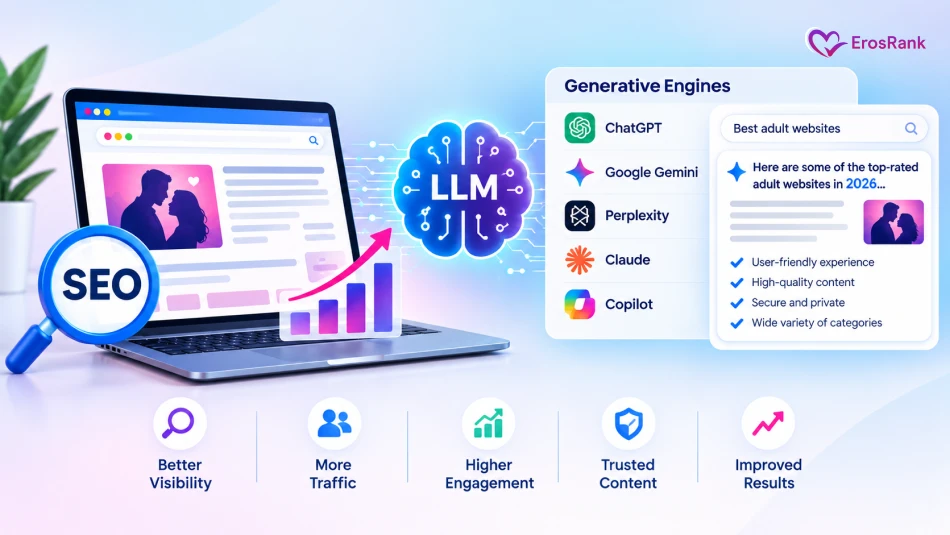
People are now using AI-powered search and chat platforms to find information, products, brands, and recommendations. This change in search behavior is also affecting adult websites.
Traditional SEO remains important, but LLM SEO, Generative Engine Optimization (GEO) & Answer Engine Optimization (AEO) can help make your content easier for AI systems and search engines to understand and potentially surface.
From creating answer-focused content & building topical authority to improving structured data, internal linking & entity signals, the right LLM optimization strategy for adult websites can strengthen an adult website’s visibility across traditional as well as AI-powered search.
This guide sheds light on practical ways to optimize adult websites for LLM SEO, GEO, and AEO while maintaining strong technical SEO and content quality.

How to Strengthen Presence of Adult Businesses and Adult Products’ Links in Generative Engines
Understanding Traditional SEO vs AEO/GEO for Adult Businesses
The following table will help you evaluate the main role of traditional SEO, AEO, GEO & LLM SEO and how each approach supports the online visibility of adult and sexual wellness businesses across traditional search engines, along with AI-powered platforms.
| Aspect | LLM SEO | Traditional SEO | AEO | GEO |
| What does it mean? | An industry term for improving how clearly website and brand information can be understood by AI-powered systems. | Optimizing websites to improve organic search visibility and user experience. | Structuring useful information so it can better satisfy direct-answer search experiences. | An industry term commonly used for improving the visibility and representation of content or brands in generative search experiences. |
| Primary objective | Make relevant information easier for AI systems to interpret and potentially surface. | Improve organic visibility, qualified traffic, and user experience. | Provide clear, useful answers to specific user questions. | Improve the discoverability and contextual understanding of content and brands in generative experiences. |
| Main platforms | AI assistants and AI-powered search experiences. | Google, Bing, and other search engines. | Search features that provide direct answers, including relevant question-based experiences. | Generative search and AI-powered search experiences. |
| How users search | Conversational and natural-language queries. | Keywords, questions, and search queries. | Direct questions and answer-oriented queries. | Conversational and detailed queries. |
| Main focus | Clear, consistent, and useful information that AI systems can interpret. | Technical accessibility, content quality, relevance, and user experience. | Answer clarity and information structure. | Content, entities, context, authority, and information accessibility. |
| What is optimized? | Website information, content, entities, and supporting signals. | Pages, content, links, and website structure. | Answers, passages, FAQs, and other answer-friendly content. | Content, entities, brand information, and contextual relationships. |
| Success indicator | Accurate brand representation, relevant mentions, citations, or visibility where applicable. | Organic rankings, qualified traffic, and conversions. | Visibility in relevant answer experiences. | Brand or source visibility in relevant generative experiences. |
| Core techniques | Technical SEO, clear content, structured information, entity consistency, and useful answer-focused content. | Technical SEO, content, internal linking, and authoritative references. | Clear answers, logical structure, and relevant supporting information. | Entity clarity, topical relevance, corroboration, and content accessibility. |
| Local Schema markup | Can provide machine-readable context when implemented correctly. | Helps eligible search engines interpret page information. | Can support structured information where applicable. | Can provide additional context where supported and relevant. |
| Third-party mentions | Can provide additional context about a brand when they are relevant and credible. | Relevant editorial references can support authority. | Can provide supporting credibility. | Consistent, credible external information can help reinforce brand context. |
| Main limitation | AI systems vary in how they retrieve, interpret, and present information. | Rankings do not guarantee traffic or conversions. | Being eligible for an answer experience does not guarantee visibility. | Visibility and representation can vary across AI systems. |
| What to measure | Brand visibility, representation accuracy, citations where available, and query coverage. | Rankings, traffic, conversions, and other business outcomes. | Answer visibility and query coverage. | Mentions, citations where available, representation accuracy, and query coverage. |
| Best strategic role | Extend a strong SEO foundation into emerging AI-powered search experiences. | Build the core search foundation. | Make useful information easier to answer and understand. | Improve how content and brands are represented in generative search experiences. |
In simple terms, traditional SEO helps users discover your adult website through search engines. AEO focuses on providing clear answers to specific questions, while GEO is commonly used to describe efforts to improve visibility & representation in generative search experiences. LLM SEO is an industry term for making website and brand information clearer and easier for relevant AI-powered systems to interpret.

How to Turn Adult eCommerce Websites Into an AI-Ready Search Asset
How AI Search Discovers and Selects Websites
Understanding the retrieval process provides a more reliable optimization strategy than chasing speculative ranking formulas. An AI search experience generally moves through several conceptual stages:
- Discovery: Search systems locate webpages, documents, media resources, along with other publicly accessible information.
- Crawling and indexing: The system processes accessible resources & determines which information enters its searchable index or retrieval ecosystem.
- Retrieval: A user query triggers the retrieval of potentially relevant sources.
- Relevance matching: The system assesses retrieved information against the user’s intent, terminology, entities, as well as contextual requirements.
- Source evaluation: Signals surrounding quality, authority, relevance, freshness, and corroboration influence source selection.
- Answer generation: The AI system synthesizes information into a response.
- Citation or recommendation: Where citations or source references are provided, selected pages become part of the visible evidence behind the generated response.
This sequence explains why simply ranking for a keyword does not guarantee AI visibility.
Why AI Search Is Different for Adult Websites
Adult SEO operates within an environment where visibility depends on more than conventional relevance signals.
Adult Content Faces Distinct Search Constraints
Different search and AI platforms apply different policies to sexually explicit material. Consequently, visibility varies according to:
- Types of queries
- Content classification
- Platform policy
- User settings
- Geographic context
- Page format
- Explicitness
- Search intent
An adult brand therefore requires a broader digital footprint than explicit media alone. Informational resources, corporate pages, creator biographies, product information, educational material, along with brand-level content, provide additional semantic surfaces through which an organization becomes identifiable.
Age Gates Introduce an Accessibility Consideration
Many adult websites use age verification and restricted access. From a search perspective, the architecture needs to distinguish between information intended for discovery & material subject to access restrictions. Important brand and discovery information should remain accessible where appropriate, while legally required age restrictions and access controls for restricted material should be maintained.
Media-Heavy Pages Often Lack Context
A video or image communicates substantial information to a human viewer, yet search systems depend heavily on textual and structural signals. A page containing a title, media file, along with a few generic words provides limited semantic context. This may consist of:
- Descriptive titles
- Meaningful descriptions
- Creator information
- Publication details
- Categories
- Transcripts where appropriate
- Related resources
- Clear entity relationships
The objective is not to surround every asset with artificial text. It is to provide genuine contextual information that explains what the asset represents.
User-Generated Content Creates Quality Challenges
Large adult platforms frequently contain profiles, uploads, comments, tags, reviews, and dynamically generated pages. Without quality controls, this ecosystem produces:
- Thin URLs
- Duplicate descriptions
- Near-identical profiles
- Empty tag archives
- Parameter variations
- Low-value search pages
A disciplined indexation framework separates valuable resources from pages that contribute little independent value.
Trust Becomes Particularly Important
Adult brands operate in an industry where authenticity, consent, identity, rights, as well as provenance carry significant importance. Therefore, clear ownership information, creator attribution, editorial standards, moderation policies, business identity & transparent contact information contribute to a more credible digital presence.
Building an LLM-Ready SEO Approach for Adult Brands
An LLM-ready SEO approach for adult businesses goes beyond optimizing pages for traditional search rankings. It focuses on making a website’s information easy for search engines & AI systems to discover, interpret, connect, as well as use when responding to relevant queries.
SEO is the strong foundation; however, the strategy must also account for entity understanding, structured information, conversational queries, topical authority, and the brand’s broader online presence. The following is a practical framework for building that foundation.
Build a Strong Technical SEO Foundation
Before optimizing for AI search, make sure search engines properly access and understand the website. AI-powered search experiences may use information retrieved from publicly available web sources, although retrieval methods can vary across platforms.
Furthermore, AI optimization cannot compensate for a technically weak website. Thus, begin with the basics:
- Ensure important pages are crawlable
- Maintain clean site architecture
- Fix broken internal links
- Use descriptive URLs
- Improve page performance
- Maintain XML sitemaps
- Avoid unnecessary duplicate pages
- Implement canonicalization correctly
- Ensure appropriate discovery information is accessible to crawlers without bypassing required age restrictions or access controls.
- Use appropriate indexing controls
- Optimize mobile usability
The main objective is not to optimize for AI through a technical trick. It is to create a website where important information is accessible, organized, as well as easy to retrieve.
Create Clear Entity Signals
AI systems need context: what is the main purpose of your adult brand website? What your adult platform consistently communicates. It must answer who you are, what you offer, where do you operate, and why users trust you & your services.
For example, a website should consistently communicate whether the business is an adult wellness retailer, product manufacturer, educational platform, marketplace, entertainment company, or another type of business. Thus, create clear and consistent information across:
- About pages
- Organization information
- Product pages
- Service pages
- Contact pages
- Author profiles
- Brand descriptions
- Category pages
- Business profiles
- Relevant third-party publications
Consistency is particularly important. If one source calls the brand an adult wellness brand, another calls it an adult retailer, and another describes it as a marketplace, the overall entity becomes less clear.
Use Structured Data Where Appropriate
Structured data helps search systems interpret the information presented on a page. Depending on the website, relevant schema types may include:
- Organization
- Product
- Article
- BreadcrumbList
- FAQPage where applicable
- LocalBusiness where appropriate
- WebSite
- Eligible review-related structured data
Here, schema should describe information that is actually present on the page. It should not be treated as a shortcut for forcing an AI system to mention a brand. Its real value is in providing clear, standardized context that supports better interpretation of existing website information.
Create Answer-Focused Content
One of the most important changes in AI search is the growing importance of question-based discovery. Instead of creating articles solely around phrases such as “adult products,” build content around the questions potential customers actually ask. Match the intent of queries, for example:
Informational questions: Here, the main intent is gaining information about something. It includes:
- What is sexual wellness?
- How do adult wellness products work?
- What should beginners consider when choosing an adult product?
- How should certain products be cleaned?
- How should adult wellness products be stored?
Comparison questions: These queries show comparison behavior when people are unsure which one to choose. They ask questions such as:
- What is the difference between product type A and product type B?
- Which material is easier to maintain?
- What features should buyers compare?
Commercial questions: The intent is to research & compare brands, products, or services before making a final decision to buy.
- What should I look for in an adult wellness store?
- How can I choose a reputable adult product brand?
- What makes an adult wellness product high quality?
Brand questions: The main purpose here is to understand the brand you are going to work with. Users ask general queries to AI systems like:
- What does ErosRank specialize in?
- Where does ErosRank operate?
- What products does ErosRank offer?
- What makes ErosRank different?
Overall, answer-focused content provides clearly defined information that may be easier for relevant search and AI systems to understand and retrieve.
Structure Content for Machine Understanding
A long article does not automatically become AI-friendly. The content should have a logical information hierarchy. The best way is:
- Descriptive H2s and H3s
- Short introductory answers
- Clear definitions
- Lists where appropriate
- Comparison tables
- Step-by-step explanations
- Relevant internal links
- Consistent terminology
- Supporting evidence
- Clear page titles and descriptions
This helps to create a clear information hierarchy:
Question → Direct answer → Explanation → Supporting information → Relevant resources
Overall, answer the main question rather than expanding the information and storytelling at the beginning. Once you have answered the actual query, then provide supporting details. This makes the page useful to both human readers as well as systems that need to extract specific information.
Build Topic Clusters Around Adult Wellness and Your Niche
A single page rarely establishes strong topical authority. Therefore, create connected content around the areas your business genuinely covers. For an adult wellness retailer, a cluster might include:
| Pillar: Adult Wellness Guide
(supporting pages cluster include) |
For a manufacturer
(the cluster could focus on) |
|
|
The objective is to establish a coherent information ecosystem rather than publishing disconnected articles.
Strengthen E-E-A-T and Trust Signals
AI systems need reliable information. Thus, adult brands should make expertise & credibility visible. Based on your adult business website, useful trust signals may consist of:
- Real author profiles
- Relevant qualifications
- Editorial policies
- Product information
- Transparent company information
- Customer support details
- Clear shipping and return policies
- Privacy information
- Safety guidance
- Independent reviews
- Reputable media mentions
- Industry relationships
- Accurate references and sources
If a topic requires professional knowledge, use an appropriately qualified contributor and clearly identify their role.
Build Third-Party Authority
Your own website is only one part of your digital footprint. Search and AI platforms can encounter information about a business across publications, reviews, directories, interviews, partner websites, industry resources, and other external sources. For that reason, adult brands should develop a credible presence beyond their own domain and strengthen domain authority through relevant, high-quality authority-building efforts.
- Industry publications
- Reputable review websites
- Business directories
- Editorial mentions
- Expert interviews
- Industry associations
- Product reviews
- News coverage
- Relevant community discussions
- Partner websites
Volume is significant, but focus on quality and relevance. A handful of credible references from relevant sources can contribute more to brand credibility than many low-quality mentions.
Make Your Adult Brand Ready for the Future of AI Search
Make Your Adult Brand Information Consistent Across the Web
Imagine a GEO system trying to answer the question “What is ErosRank?”. It may encounter information from the brand’s website, review websites, business profiles, publications, product pages, along with other sources.
Moreover, if all of these sources communicate similar information, the entity becomes easier to understand. Maintaining consistency around the following is crucial:
- Brand name
- Company description
- Products
- Services
- Locations
- Industry category
- Founding information where relevant
- Expertise
- Key differentiators
This is an important part of LLM visibility services for adult businesses because how a brand is understood online can be influenced by information available beyond its own domain.
Optimize Product and Service Information
For adult eCommerce brands, product information deserves particular attention. GEO systems need enough context to understand adult products accurately. A robust product page clearly communicates:
- The list of products you are selling (including names)
- Each product’s unique features
- Categories under which your adult product is displayed
- Materials used to make the products
- Relevant dimensions (size, width, height & weight, etc.)
- Care instructions for use
- Compatibility
- Shipping information
Experts recommend avoiding vague descriptions filled with repetitive keywords. Instead, create useful product content that answers genuine purchasing questions and provides accurate information throughout the buying journey.
Clear, specific & consistent product data can help search engines, along with relevant AI-powered systems, better understand product information and potentially retrieve it for relevant queries.
Develop an FAQ Strategy for LLM Optimization
FAQs support both AEO and traditional SEO when they address genuine customer questions. Good FAQs provide direct and useful answers.
For instance, what should I consider when buying an adult wellness product? The answer should focus on the product’s intended use, materials, features, cleaning requirements, compatibility, along with the reputation of the seller or manufacturer.
Your goal must be to create some common FAQs your targeted audience often asks Google & GEO systems for every page you write. This can help improve coverage of genuine customer questions and make important information easier for users and relevant search systems to understand.
Optimize for Conversational Search
AI search changes the way people formulate queries. Earlier, people used Google and other search engines to ask questions, using phrases or keywords like “best adult dating website”. However, since conversational GEO systems came into existence, people search like “I’m new to adult wellness products. What should I consider before buying one?”
Therefore, adult brands should create content that answers natural-language questions, uses clear terminology, and covers the broader context around a topic rather than focusing only on individual short-tail keywords. Traditional keyword optimization still matters, but it should be supported by useful information that helps search engines and AI systems understand user intent, products, and relevant topics.
LLM-focused SEO for adult websites strengthen the clarity, structure, and consistency of information that relevant AI-powered search systems may use to understand a brand and its content.
Monitor How AI Systems Represent Your Brand
Treat LLM optimization as an ongoing process, not a one-time technical implementation. After publishing & optimizing content, regularly test how relevant AI search platforms represent your business.
Create a set of prompts covering different stages of the customer journey, such as informational, commercial, comparison, local, as well as brand-specific searches. Evaluate the following factors:
- Whether your brand appears
- How frequently it appears
- Which competitors appear
- Whether your business is described correctly
- Which pages or sources are referenced
- Whether product information is accurate
- Whether important services are missing
- Whether incorrect information appears
This not only provides a baseline for measuring AI visibility, but also identifies areas that need improvement. To exemplify, if an adult brand appears for broad informational questions but is consistently absent from commercial comparisons, the content and authority strategy may need to focus more heavily on those commercial topics.
The final step is to analyze where the brand is visible, where it is not, and how accurately it is represented.
Common LLM SEO Mistakes Adult Brands Should Avoid
These are:
- Keyword stuffing: Repeating “adult SEO,” “adult website SEO,” or “LLM SEO” excessively does not create meaningful authority. Therefore, use relevant terminology naturally.
- Creating content solely for AI: Content should be useful to people first. AI systems are not the audience. They are an additional discovery layer.
- Publishing large volumes of generic AI-generated articles: More pages do not automatically mean more visibility. Thin, repetitive, inaccurate content can weaken your adult website’s overall quality.
- Ignoring traditional SEO: Technical SEO, crawlability, information architecture, internal linking, as well as search intent remain important.
- Treating schema as an AI ranking hack: Structured data should accurately represent visible page information.
- Building low-quality backlinks: A large number of irrelevant links is not a substitute for genuine authority.
- Ignoring platform policies: AI & search platforms have their own policies and limitations. Sustainable visibility requires working within those frameworks rather than trying to circumvent them. Adult businesses should also understand how Google guidelines apply to adult SEO when developing their search strategy.
- Making unsupported claims: Adult businesses should be particularly careful with claims about products, safety, health, performance, or effectiveness. Information should be accurate and appropriately qualified.
The Future of LLM SEO for Adult Websites
The future of LLM SEO for adult websites will become more advanced over time. The way different AI platforms retrieve information, select sources, generate answers, as well as display citations can change over time. That means adult brands should make an LLM SEO strategy around the following fundamentals:
- High-quality content
- Strong technical SEO
- Clear entity signals
- Reliable information
- Topical authority
- Credible external references
- Strong user experience
- Transparent business information
- Continuous measurement
An ideal LLM SEO strategy helps your brand be visible across both traditional as well as AI-driven search environments. The future is not necessarily about choosing between SEO and AI search optimization. It is about building websites that work well for both people & intelligent search systems.
The Bottom Line
For adult websites, simply ranking in traditional search is no longer enough. Your content, brand, expertise, and website signals must also be clear and trustworthy enough for AI systems to understand and reference.
LLM SEO, GEO, and AEO work together to make that possible. A strong LLM-focused SEO strategy for adult websites builds a digital presence that is clear, credible, technically accessible, context-rich, and consistent across your website.
AI-powered search is changing how people discover and evaluate adult brands. A strong LLM-focused SEO strategy can help your business become easier to find, understand, and trust across evolving search experiences.
By keeping the above-mentioned aspects in mind, adult businesses can build lasting visibility instead of chasing short-term tactics. The goal is simple: create a digital presence that works for people and AI alike.
Frequently Asked Questions
What is LLM-focused SEO for adult websites?
LLM-focused SEO for adult websites is an approach that helps make important brand, content, product, & service information clearer and easier for relevant AI-powered search systems to understand. It combines strong technical SEO with structured information, entity signals, answer-focused content, topical authority, along with credible third-party references.
As a reliable LLM SEO agency, we help adult businesses develop an LLM-ready digital presence by identifying information gaps, improving website structure, strengthening brand signals, and creating useful content that supports both traditional as well as AI-powered search experiences.
How is LLM SEO different from traditional SEO for adult websites?
Traditional SEO primarily focuses on improving a website’s visibility in search results. LLM-focused SEO adds another question: How clearly can AI-powered systems understand the brand, its expertise, products, services, and supporting information?
Our adult SEO experts combine both approaches because strong traditional SEO remains an important foundation. We help improve crawlability, website architecture, content quality, topical relevance, structured information, and authority while also considering how information may be interpreted across AI-powered search experiences.
How can ErosRank help my adult business with LLM visibility?
We provide LLM visibility services for adult businesses designed around the specific challenges of the adult industry. We assess how clearly your business, services, products, and expertise are communicated across your website & the wider web.
Why should an adult business choose ErosRank for LLM SEO?
We understand that an effective strategy requires more than generic SEO tactics. Our LLM visibility services for adult businesses combine technical SEO, content strategy, entity development, structured information, authority building & ongoing visibility analysis.
We help adult and sexual wellness brands build a stronger, clearer, as well as more credible digital presence that supports traditional search performance while preparing their information for the evolving landscape of AI-powered search.
Additionally, our SEO strategies are developed in alignment with applicable Google guidelines and SEO best practices while considering relevant platform policies and content restrictions.
How LLM Improves The Results in Generative Engines and AI Mode?
LLM-focused SEO helps improve results in generative engines and AI Mode by making an adult brand’s information clearer, more consistent, and easier for AI systems to understand. These systems evaluate signals from websites, business profiles, reviews, directories, publications, and other authoritative digital sources when generating answers and recommendations.
For adult brands, we strengthen these signals through adult-business entity recognition, wellness product entity mapping, semantic topic authority, prompt and query coverage, structured data, LocalBusiness schema, Google Business Profile signals, brand mentions, and authoritative content. This helps AI systems better understand the brand, its products or services, locations, expertise, and relevance to specific user queries.

Get Your Free SEO Plan