








Key Takeaways
- BSR Is Driven by Sales, Not Just Rankings: Amazon Best Sellers Rank depends primarily on sales performance, with recent sales carrying greater weight.
- Choose the Right Category & Keywords: Accurate categorization, strategic keyword targeting, & optimized listings help your sexual wellness product reach the right shoppers.
- Turn Traffic Into Conversions: Strong product pages, compelling images, clear product information, competitive pricing, and EBC Content can help turn clicks into customers.
- Stay Compliant While Standing Out: Sexual wellness products require careful attention to Amazon’s rules around claims, imagery, advertising & Store content. A compliant strategy protects both visibility & long-term growth.
- Build a Data-Driven Growth Engine: The path to becoming a Best Seller is continuous: Research → Optimize → Advertise → Measure → Test → Scale—using BSR, sales, conversion, PPC, keyword, inventory, and customer data to guide decisions.
What if your sexual wellness product is genuinely great, but customers never find it on Amazon?
In a category where customers have endless choices and often hesitate before making a purchase, simply having a quality product is not enough. You need visibility, trust, compelling branding, and the best strategy to sell sexual wellness products on Amazon that also turns curious shoppers into confident buyers.
So, how do you make your product stand out, climb Amazon’s rankings, and become a Best Seller in the highly competitive sexual wellness category? The answer starts with understanding how Amazon measures product performance.
Amazon Best Sellers Rank (BSR) compares a product’s sales performance with others in its category, with recent sales carrying more weight than older sales. Unlike organic search ranking, BSR is primarily tied to sales performance.
Let’s explore the strategies that can help your brand get noticed, win customer trust, and build sustainable sales on Amazon.

Turn Your Sexual Wellness Product Into an Amazon Best Seller!
Understand How Amazon Best Sellers Rank Works for Sexual Wellness Products
Before developing an Amazon Best Seller strategy, you need to understand BSR. Best Sellers Rank is not the same as Amazon organic search ranking.
Amazon search ranking determines where a product appears when a shopper searches for a particular term. BSR measures how well a product is selling compared with other products within a relevant Amazon category. Amazon states that BSR is tied to sales volume and that recent sales have greater influence than older sales. For instance, a sexual wellness product may rank highly for a keyword such as “water-based lubricant” but still have a relatively weak BSR if competing products are generating substantially more sales.
Now, this creates two different objectives:
- Amazon SEO: Increase visibility for relevant searches.
- BSR growth: Increase product sales relative to competing products.
Here, understand that Amazon does not have a specific best-seller sales threshold. It means that whether your brand sells 100 sexual wellness products in one day, it will not appear as the best-selling product. The required sales volume depends on the category, marketplace, competition, product demand, as well as the sales performance of competing ASINs.
A professional Amazon marketing strategy helps to establish a category-specific competitive benchmark rather than promise a fixed number of sales.
What experts measure: For every targeted product, adult SEO experts first analyze the following factors:
- Current BSR
- Category & subcategory
- Top-ranking competing ASINs
- Recent sales performance
- Organic keyword rankings
- Product-page traffic
- Conversion rate
- Advertising performance
- Pricing
- Reviews & ratings
- Inventory availability
This report helps identify the actual differences between the products currently leading the category and the client’s ASIN (Amazon Standard Identification Number).
Amazon Best-Seller Strategies for Sexual Wellness Product Listings to Boost Sales
The following are proven strategies to optimize your Amazon sexual wellness product listings and improve the best seller rank:
Find the Right Amazon Category and Ranking Opportunity
Amazon explains that BSR is relative to other products in the same category and recommends selecting a specific and accurate product category. Products can also have multiple BSRs when they appear in multiple categories.
Therefore, before optimizing keywords or launching advertising campaigns, establish whether the product is competing in the right Amazon category and browse nodes. Since Best Sellers Rank (BSR) is calculated relative to other products within a category, the competitive environment directly affects the level of sales required to achieve a strong position.
- Review the Product’s Amazon Classification: Start by auditing the following factors:
- Product category
- Subcategory
- Browse node
- Parent ASIN
- Child ASINs
- Product variations
- Category relevance
- Competing ASINs within the same category
To improve ranking, the goal is not to move a product into a less competitive category. Instead, the objective is to place the product in the most accurate as well as relevant category based on Amazon’s catalog structure.
- Identify the Category Opportunity: Once the classification is confirmed, analyze the leading products in that category, particularly the:
- Top 3 ASINs
- Top 10 ASINs
- Top 20 ASINs
- BSR levels
- Selling prices
- Ratings
- Review volume
- Product types
- Sales patterns
- Promotions & offers
This plays a significant role in creating a best-seller competitive benchmark and shows how the product compares with established category leaders.
Analyze What Makes Amazon’s Sexual Wellness Best Sellers Successful
The strongest competitors provide useful information about what customers are already responding to. However, competitor research should not mean copying another product’s content. It should identify patterns, gaps, along with competitive advantages. Analyze the leading ASINs:
| Product performance | Product offer | Customer trust | Amazon SEO | Product-page presentation | Advertising presence
(Review here observable) |
| BSR
Category position Subcategory position Sales trend where reliable data is available |
Price
Size Quantity Pack configuration Variations Promotions Coupons or deals where applicable |
Star rating
Review volume Recent review activity Common positive feedback Recurring complaints |
Primary keywords
Keyword placement Title structure Bullet points Product description Product attributes Search visibility |
Main image
Secondary images Product graphics A+ Content Brand presentation Product differentiation |
Sponsored placements
Keyword targeting Product targeting Advertising frequency |
For instance, if a competitor has stronger organic visibility but a similar product offer, the gap may be primarily related to keyword coverage and listing optimization. If the client receives substantial traffic but converts poorly, the problem is more likely to involve the product page, offer, pricing, reviews, or product positioning.
Build an Amazon Keyword Strategy for Adult Products
Amazon recommends using relevant keywords naturally across product titles, bullet points, descriptions, as well as backend search terms, while avoiding keyword stuffing. It also recommends using relevant product features, attributes, alternate names, and related terms in search-term research. For sexual wellness products, organize keyword research by product relevance and search intent.
- Primary product keywords: These describe the product itself, such as personal lubricant, sexual wellness products & intimate wellness products. The exact terms depend on the product being optimized.
- Feature-based keywords: These describe legitimate product characteristics, such as: fragrance-free, body-safe, long-lasting, travel-size, water-based. Here, the main thing to keep in mind is to include only characteristics that accurately help describe and optimize sexual wellness product listings.
- Use-case keywords: These types of keywords describe how customers intend to use the product, such as lubricant for couples, personal lubricant for intimate use, intimate wellness products for couples, etc. Make sure the terms you use to describe the sexual wellness products correspond with the product you are offering.
- Long-tail keywords: Long-tail searches can be more specific than broad category terms, as they may reveal clearer commercial intent. For instance, rather than searching for grow adult commerce sales, you can search for: grow adult commerce sales on Amazon.
- Map keywords to Amazon assets:
| Amazon asset | Primary purpose |
| Title | Core product and relevant primary terms |
| Bullet points | Features, benefits and supporting terms |
| Description | Detailed product information |
| Backend search terms | Relevant additional search terms |
| A+ Content | Product education and supporting information |
| PPC campaigns | Search-term discovery and qualified traffic |
Avoid unnecessary duplication, and do not use backend search terms for relevant keywords already adequately represented in the visible listing.
Optimize the ASIN for Amazon Organic Search
Keyword research only becomes useful when it is translated into a well-structured product listing. Amazon identifies titles, bullet points, descriptions, images, and search terms as important components of product-listing optimization.
- Optimize the product title: A product title should communicate the information customers need to identify the product. Depending on the product, this may consist of brand, product name, relevant features, size, and variation. Incorporate the primary keyword naturally rather than repeating it unnaturally.
- Optimize bullet points: Bullet points should explain the product’s key characteristics, such as materials, formulation, quantity, included components, differentiating features, and relevant benefits. The content should answer practical purchase questions rather than simply repeat keywords.
- Optimize the product description: Use the description to explain the product and its characteristics. Also, utilize relevant secondary terms naturally while keeping product information clear & accurate.
- Optimize backend search terms: Backend search terms can support discoverability for relevant terms that do not fit naturally into the visible listing. Avoid Competitor brand names where prohibited, irrelevant keywords, and repetitive & misleading terms. Amazon specifically recommends relevant search terms and warns against keyword stuffing.
- Optimize product attributes: Accurate product attributes help Amazon understand what you are selling and allow shoppers to filter & evaluate products. For sexual wellness products, accuracy is particularly important because misleading claims or incorrect classification can create compliance issues.
To see how a data-driven SEO strategy can improve visibility and organic performance, explore this adult eCommerce SEO case study.
Optimize the Product Detail Page for Conversion
Organic visibility creates an opportunity to generate traffic, but the product page must convert that traffic into orders. The basic performance path is: Impressions → Clicks → Product Detail Page Visits → Conversion → Orders
A product with strong search visibility but weak conversion may struggle to generate the sales volume required to compete for a stronger BSR. Consider the following factors:
Review the main conversion elements: Analyze the main image, product title, price, review count, rating, secondary images, product information, A+ content, product differentiation, and applicable promotions.
- Main image: Customers should be able to identify the product quickly in search results.
- Product information: The listing should clearly communicate what the product is and what the customer receives.
- Product differentiation: The page should clearly show the product’s legitimate differences without relying on unsupported claims.
- A+ Content: For eligible brands, A+ Content provides additional space for product education, comparisons, as well as visual explanations.
Amazon’s Manage Your Experiments feature also lets eligible brands test certain product content. Thus, follow clinical language in the descriptions and content along with specific H1, H2, and so on. Results can consist of conversion rate, sales & units sold per unique visitor. This lets you optimize listings based on measured performance rather than assumptions.

Build a High-Converting Product Page to Boost Your Best-Seller Rank
Follow Amazon’s Sexual Wellness Content and Product Requirements
Amazon permits certain sexual wellness products but restricts claims and presentation. Its current store policies state that sexual wellness products must not make claims related to increasing sexual performance or boosting libido, and must not explicitly reference private, intimate, or sensitive physical or medical conditions. (Amazon Ads)
- Product claims: Avoid unsupported claims relating to sexual performance, medical conditions, libido, diagnosis, treatment, sensitive physical conditions, as well as sensitive bodily functions. Product information must describe the actual product rather than promise outcomes that cannot be substantiated or that Amazon does not permit.
- Images and creative: Never display explicit human anatomy, nudity, or suggestive models, as Amazon’s Store creative policies restrict nudity, images drawing undue attention to intimate body parts, explicit sexual content, sexual activity, sexually suggestive poses, along with provocative sexual presentation. You can present the product clearly, but creatives must meet Amazon’s applicable content standards.
- Sexual wellness Store structure: Amazon’s Store policies also state that sexual wellness products should not be mixed with non-sexual wellness products. Where applicable, place sexual wellness products within an appropriately labeled Store subpage, such as “Sexual Wellness.” Amazon also specifies additional requirements for Stores containing adult products.
- Compliance is part of Amazon SEO: A product listing should therefore be reviewed across: Product classification → Listing copy → Images → Store → Advertising → Claims
Thus, a keyword strategy that introduces prohibited or unsuitable language is not a sustainable SEO strategy. This compliance-first approach should also extend to broader SEO, where adult &sexual wellness brands need to ensure their content and keyword strategies align with applicable search-engine guidelines.
Build a Sales-Velocity Strategy
This is the point where Amazon SEO connects directly with Best Seller performance. Amazon states that BSR is calculated from sales volume & that recent sales count more heavily than older sales. It also explicitly states that page views and reviews do not directly influence BSR.
Therefore, the objective is not simply to increase impressions or keyword rankings; the goal is to generate relevant traffic that results in product sales. The performance chain works like:
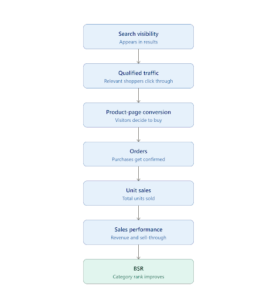
This does not mean that every additional visit or keyword ranking will automatically improve best seller ranking. The important metric is the resulting sales performance relative to other products in the category.
Establish a competitive sales benchmark: Instead of setting an arbitrary target, you must monitor:
- Current product sales
- Competitor performance
- Category demand
- Recent sales trends
- BSR movement
- Units sold
- Revenue
Base the target on the product’s category and competitive environment.
Use Amazon PPC to Generate Qualified Product Traffic
Amazon PPC can support sales generation when the product & campaign are eligible under Amazon’s advertising policies. Depending on the product, marketplace & placement, available advertising options and restrictions can vary. Sexual wellness products should therefore be checked against the applicable advertising policy before launching campaigns.
Amazon’s policies also restrict certain sexual content, claims, and creative elements in advertising.
- Build campaigns around search intent: A PPC structure can separate:
- Discovery campaigns: Used to identify relevant search terms and placements.
- High-intent keyword campaigns: Used to focus budget on proven, commercially relevant searches.
- Product targeting: Used where the product and targeting option are eligible.
- Brand campaigns: Used where applicable to capture branded search demand.
The exact campaign structure should depend on the product, marketplace, advertising eligibility, along with available search volume.
- Evaluate search terms by sales performance: Review the following aspects:
- Impressions
- Clicks
- CTR & CPC
- Spend & Orders
- Conversion rate
- ACOS & ROAS
The purpose is not to maximize clicks. It is to identify traffic that contributes to profitable product sales.
Use PPC Search Data to Improve Amazon SEO
PPC & organic Amazon SEO can provide useful data for one another. A paid campaign can reveal which customer searches generate actual orders. For instance, the search term “sexual wellness products Amazon Best Seller” gets:
- Receives clicks
- Generates orders
- Demonstrates commercial relevance
- Organic ranking is evaluated
- Relevant listing content is optimized
- Organic visibility is monitored
This creates a practical connection between paid search data & organic keyword strategy.
Furthermore, Amazon’s guidance on keyword research supports using relevant search terms across product content as well as advertising, while Brand Analytics tools available to eligible brands can provide customer search & purchasing insights. However, PPC data should not automatically be transferred into the listing. A search term should first be evaluated for:
- Product relevance
- Customer intent
- Conversion performance
- Content suitability
- Amazon policy compliance
Improve Conversion Without Creating Policy Issues
Sexual wellness products require a balance between effective product communication & appropriate presentation. Therefore, a product page ought to make it easy to understand:
- What the product is
- What it contains or is made from
- Size
- Quantity
- Key features
- Included components
- Appropriate use information
- Product differences
Use educational product content: Depending on the product & Amazon’s requirements, useful content consists of:
- Product diagrams
- Feature graphics
- Dimensions
- Materials
- Specifications
- Comparison tables
- Neutral product photography
This can communicate product value without relying on explicit imagery or sexualized creative. Amazon’s Store policies permit verbal descriptions & abstract illustrations in certain contexts while restricting explicit and sexually suggestive visual content.
Use controlled testing: For eligible ASINs, test one major listing variable at a time where practical. For example, evaluate the main images, bullet point structure, A+ content, modules, along with product positioning. Then, evaluate modifications by using CTR, conversion rate, units sold, and revenue. The main goal is to evaluate changes that boost measurable product performance.
Build a Compliant Review and Customer Trust Strategy
Amazon explicitly states that customer reviews do not influence BSR calculation. Their value is primarily related to customer confidence and conversion.
- Analyze review data: Explore recurring themes involving packaging, size, materials, instructions, product performance, customer dissatisfaction, and more. This information helps to identify actual issues that SEO might have missed.
For example, if a customer complains that the product size is not clear. The solution may be to improve product images along with different dimensions or size options.
- Use Amazon-compliant review methods: Sexual wellness brands can participate in Amazon’s permitted review programs and processes rather than attempting to generate artificial reviews. Keep in mind that manipulating reviews, creating fake reviews, or offering incentives for positive reviews can not only violate Amazon’s policies, but also put your account at risk.
Use Pricing and Promotions to Support Sales
Amazon identifies competitive pricing as one factor sellers can consider when working to improve sales along with BSR. Experts analyze competitor pricing, product ratings & reviews, coupons, eligible deals, as well as pack quantity, etc.
Measure price changes against sales performance: While evaluating the price, use the following criteria:
Price → CTR → Conversion → Units sold → Revenue → Profitability
Reducing price is not automatically an improvement if it significantly decreases margin without producing enough additional sales. Similarly, a higher-priced product can remain competitive when its product proposition, customer trust, plus conversion performance support the price.
Protect Sales Performance Through Inventory Availability
A product cannot convert traffic when the relevant variation is unavailable, and a marketing campaign should account for inventory before increasing traffic. Here, there is a need to monitor aspects like:
- Available inventory
- Average daily unit sales
- Inventory coverage
- Reorder requirements
- Supplier lead time
- FBA availability where applicable
- Expected demand from campaigns & promotions
Connect advertising with inventory: Before increasing campaign budgets, check whether the product has sufficient inventory to support the expected demand. Consider a simple operational sequence:
Forecast demand → Check inventory → Increase traffic → Monitor sales → Replenish
This becomes increasingly crucial when a product is already generating a high volume of orders.
Track the Metrics Behind Amazon Best Seller Performance
A useful Amazon SEO report should connect search visibility with sales outcomes. This includes:
| Search metrics | Product-page metrics | Sales metrics | Advertising metrics | Customer metrics |
| Keyword rankings
Search impressions Organic sessions CTR Keyword coverage |
Detail-page sessions
Conversion rate Units sold Revenue Units sold per unique visitor |
Daily unit sales
Weekly unit sales Sales trend Revenue BSR Category rank Subcategory rank |
Spend
Impressions CTR CPC Orders Conversion rate ACOS ROAS TACOS |
Rating
Review volume Recent review trend Return rate Recurring complaints |
Measure relationships, not isolated numbers. A keyword moving from position 20 to position 10 is useful, but the business impact becomes clearer when that movement is connected to:
Higher visibility → more qualified traffic → more orders → stronger sales performance
This prevents Amazon SEO reporting from becoming a list of keyword positions without commercial context.
Diagnose Why a Sexual Wellness Product Is Not Becoming a Best Seller
When an ASIN is not progressing toward a stronger category position, you must evaluate the limiting factors such as:
- Low search visibility: It happens when your keyword coverage is weak, along with poor indexing, low relevance, limited search demand, and incorrect classification. To overcome these issues, review category, indexing & keyword coverage.
- High impressions but low CTR: A low click-through rate may result from a weak title, unclear product positioning, a poor main image, an uncompetitive price, etc. To prevent such problems, evaluate the search-result presentation and test eligible listing elements.
- High traffic but low conversion: The main reasons behind the low conversion rate may be due to weak product-page content, insufficient product information, poor product differentiation, limited customer trust, as well as unclear pricing. To increase leads, conduct a product-detail-page & conversion audit.
- Good conversion but insufficient sales volume: This happens because qualified traffic is insufficient. Expand relevant keyword coverage, plus evaluate eligible advertising opportunities.
- Good sales but weak BSR: Competitors in the same category are generating more sales. To resolve this, compare sales performance, category competition, as well as recent trends rather than assuming the listing itself is the only problem.
- Sudden decrease in performance: To identify causes of an unexpected performance decline, investigate inventory, advertising status, promotions and policy issues, competitor activity, keyword visibility, and listing & price changes. This diagnostic model allows you to separate visibility problems, conversion issues, traffic problems & competitive sales gaps.
For a practical example, see a case study of how we helped an adult eCommerce brand drive growth.

Want to Become the Best Sexual Wellness Product Seller on Amazon?
Technical Amazon Best Seller Framework – How ErosRank Helps You to Become a Top Brand of Sexual Wellness Products
We build a structured Amazon growth strategy requires more than optimizing a product listing once. Our experts typically work through the following stages:
Stage 1: Category & Market Analysis
First, we determine the most appropriate Amazon category & subcategory for the product and assess the competitive landscape within that segment. Then, evaluate leading products, price ranges, demand patterns, as well as category-level competition to establish realistic performance benchmarks.
Stage 2: Competitor & ASIN Analysis
Analyze leading ASINs at the listing and performance levels. Our experts examine the keyword coverage, titles, bullet structures, image presentation, variations, promotions, and advertising visibility. The objective is to identify competitive strengths, content gaps, along with opportunities for differentiated positioning.
Stage 3: Keyword Research & Search-Term Mapping
At this stage, our team builds a keyword database using relevant product terms, attributes, use cases, long-tail queries, as well as customer search behavior. Then, map keywords to specific listing elements based on relevance & search intent. This prevents unnecessary keyword repetition while making sure important search terms appear in the right fields.
Stage 4: Technical Listing Optimization
The product detail page is optimized based on the keyword map and competitive findings. Here, we refine the title, bullet points, description, backend search terms, attributes, images & EBC content while maintaining accurate product information and natural customer-focused messaging. Each element is structured to support Amazon discoverability and informed purchase decisions.
Stage 5: Conversion Rate Optimization
Once the listing attracts relevant traffic, our team of experts evaluates how effectively that traffic converts. They analyze indicators such as sessions, unit-session percentage, click-through rate, sales, along with customer behavior. Eligible Amazon testing tools can then not only compare variations of listing content but also determine which version performs better.
Stage 6: Compliance & Risk Review
Before scaling visibility, we review the sexual wellness product listing and campaigns for Amazon’s applicable requirements. This contains:
- Checking product classification
- Claims
- Imagery
- Terminology
- Store content
- Advertising creatives
- sexual wellness-specific restrictions
Compliance is treated as an ongoing control rather than a final checklist.
Stage 7: Targeted Traffic Acquisition
Our team sets up eligible Amazon ad campaigns based on keyword intent, match types, product targeting, placements, bids & budgets. Campaign data is then analyzed to identify keywords, products, as well as placements generating qualified traffic & sales.
Stage 8: Sales & Performance Monitoring
Track units sold, revenue, conversion rate, sales velocity, BSR, ad-attributed sales, and advertising efficiency. These metrics are compared over time to identify performance changes as well as determine where optimization is needed.
Stage 9: Continuous Optimization & Scaling
Our SEO experts use performance data to refine keywords, listing content, PPC, pricing, promotions, product presentation & inventory planning. Strong-performing elements are scaled gradually, while weaker areas are tested and adjusted. The framework follows a continuous cycle:
Research → Implementation → Measurement → Testing → Optimization → Scaling
Becoming a strong seller in Amazon’s sexual wellness category is not the result of a single listing optimization. It requires continuous technical analysis of key factors such as search visibility, competitive movement, and sales data.
Conclusion
Understanding the sexual wellness market on Amazon is crucial to becoming an Amazon best seller in the sexual wellness category. It requires a proven product strategy that consistently turns visibility into qualified traffic, traffic into conversions, and conversions into sustainable sales performance.
By keeping the strategies above in mind, you can lead the Amazon sexual wellness market. From choosing the right product & understanding customer demand to optimizing keywords & continuously improving your campaigns, every step pays off in long-term growth.
If you also want to turn your sexual wellness product into a stronger Amazon performer?
Contact experts at ErosRank. We help you position your brand for sustainable growth in one of Amazon’s fastest-evolving categories.
Frequently Asked Questions
How Long Does It Take to Become an Amazon Best Seller?
There is no reliable universal timeframe. The timeline may vary depending on the:
- Existing product demand
- Category competition
- Current BSR
- Product conversion rate
- Search visibility
- Review profile
- Inventory
- Sales volume
A new ASIN competing in a highly competitive category may require substantially more sales activity than a product competing in a smaller subcategory. Therefore, a realistic Amazon growth plan should establish baseline performance, competitive benchmarks, as well as measurable milestones instead of promising a specific number of days to reach a Best Seller position.
How can I improve Amazon rankings for sexual wellness products?
The best way is to improve keyword relevance, listing conversion, sales performance, customer feedback, advertising efficiency, along with inventory health. We use Amazon SEO, PPC data, and ongoing optimization to help products gain more relevant visibility.
How can I become an Amazon best seller in the sexual wellness category?
To become an Amazon best seller in the sexual wellness category, you must:
- Optimize the product listing
- Target relevant keywords
- Maintain competitive pricing
- Build positive reviews
- Run compliant Amazon Ads
- Keep inventory consistently available
We help brands improve Amazon sexual wellness product visibility, rankings, along with sales through data-driven Amazon optimization.
How can I optimize sexual wellness product listings on Amazon?
Focus on relevant keywords, clear benefit-led copy, strong images, A+ Content & accurate product information. We combine Amazon SEO with conversion-focused optimization while keeping every element aligned with Amazon guidelines.
What Amazon policies apply to sexual wellness products?
Amazon requires sexual wellness listings and ads to follow its product, content & advertising policies. Avoid explicit imagery, nudity, prohibited claims, misleading medical statements, along with non-compliant language. ErosRank focuses on policy-conscious optimization to reduce compliance risks.
How can I grow adult commerce sales without violating Amazon policies?
Prioritize compliant products, professional content, non-explicit creative, accurate claims & approved advertising methods. We at ErosRank help brands find growth opportunities while keeping Amazon compliance at the center of the strategy.
Can an Amazon optimization agency help my sexual wellness brand grow?
Of course! ErosRank helps sexual wellness brands with Amazon SEO, listing optimization, PPC management, competitor research, conversion optimization, compliant content, and performance tracking, all focused on sustainable Amazon growth.

Get Your Free SEO Plan



 English
  Spanish
  French
  Dutch
Dutch